
Last updated October 16, 2026
Free on-site gate assessment - hinges, posts, and your LiftMaster or Nice gate operator checked before anything is quoted
The assessment is free and the quote is the invoice.
Get your free estimateGate Repair Permits, Codes & Inspections in CA: What You Need to Know
Most gate repairs in California never come within a mile of a permit counter. A hinge swap, a new opener arm, a wheel replacement – these are maintenance items, and no jurisdiction in San Diego County treats them as construction. But the repairs that do trip the permit wire are precisely the ones where skipping the paperwork costs the most later. When an automatic gate sits beside a pool, an insurer’s first question after an accident will be whether the installation was ever inspected. If the answer is no, the claim conversation changes fast. This guide walks through which gate work is exempt, which triggers a permit, which code sections actually bind you, and how to get an older unpermitted gate into compliance without tearing the whole thing out.
Quick Answer
In California, most gate repairs – replacing an actuator, motor, hinge, wheel, or control board – are permit-exempt maintenance. A building permit is generally required only for new gate footings or structural posts, and an electrical permit is required when adding a new circuit or sub-panel to power an automatic gate. Gate operators installed near a swimming pool must also meet the entrapment-protection requirements of UL 325 and the California Building Code, regardless of whether a permit was pulled. For our Gate Repair services in San Diego, call Portcullis Gate Repair at (619) 793-3558 for a free estimate.
Styles & brands we work with
- Wrought iron
- Wood & steel frame
- Farm & ranch
- Sliding driveway gates
- LiftMaster operators
Table of Contents
- Which Gate Repairs Are Permit-Exempt in California
- The Narrow Category of Work That Does Require a Permit
- California Building Code Sections That Apply to Automatic Gates
- UL 325 and Entrapment Protection: What Inspectors Actually Check
- San Diego City vs. San Diego County: How the Jurisdictions Differ
- HOA CC&Rs: The Third Layer Nobody Mentions
- As-Built Documentation: Bringing an Older Unpermitted Gate Into Compliance
- The Inspection Process: Timeline and What the Final Covers
Which Gate Repairs Are Permit-Exempt in California
California building law draws a clean line between maintenance and construction, and most gate work falls on the maintenance side. The California Residential Code (CRC), Section R105.2, lists repairs that are exempt from permit requirements. A repair is exempt when it replaces worn or broken parts with equivalent components and does not alter the structure, the electrical system, or the means of egress.
In plain terms, here’s what that covers for a gate:
- Actuator replacement – swapping a failed FAAC, BFT, or Linear actuator for a new unit with the same mounting footprint and voltage.
- Control board replacement – replacing a burnt circuit board with a factory-matched part.
- Hinge and wheel replacement – replacing a roller or hinge with a component of similar or better rating.
- Gate operator motor swap – removing a dead Viking motor and installing a new one of the same horsepower and voltage.
- Photo eye and safety edge replacement – installing new entrapment-protection sensors to restore proper function.
- Track and guide repair – straightening or replacing slide-gate track sections without changing the gate’s location.
None of this requires a permit in any jurisdiction in San Diego County. The reason is that the CRC considers these replacements as ordinary maintenance: the gate’s structural loading, electrical draw, and safety characteristics remain unchanged from the original installation. That said, the equipment you install carries its own legal obligations. A replacement actuator must still be installed so that it complies with UL 325’s safety requirements, which we cover below. Working on a 120- or 240-volt circuit is not a permit-exempt repair – the wiring side of an automatic gate remains regulated electrical work.
The Narrow Category of Work That Does Require a Permit
Three types of gate work in California reliably cross the permit threshold. Understanding which three matters, because this is where unpermitted work turns into denied insurance claims.
- New gate post footings. If you are installing a new gate or replacing a post that requires excavating and pouring a concrete footing, the CRC treats this as structural work. Section R105.1 requires a building permit for any structure that relies on a foundation, and a gate post footing is classified as such. In San Diego’s expansive clay soils, an undersized footing that shifts over a wet winter is the most common cause of gate sag we repair.
- New electrical circuits or sub-panels. Running a dedicated circuit from your main panel to power a gate operator is new electrical work, governed by the California Electrical Code. It requires an electrical permit and an inspection of the rough and final stages. This is true even if the gate itself is existing.
- Automated gate installation within 5 feet of a pool or spa. California has a specific requirement that any automatic gate providing access to a pool enclosure must comply with the entrapment protections of UL 325 and be installed with a permit in most local jurisdictions. If the gate controls access to the backyard where a pool sits, the pool code (CRC Chapter 31) applies. The gate must be self-closing, self-latching, and open away from the pool.
If you bought a home with an automatic gate and you don’t know whether a permit was pulled, the records branch of San Diego’s Development Services Department can do a permit-history search based on address. Many homeowners in older neighborhoods like Clairemont, Allied Gardens, and San Carlos discover the original gate predates their ownership and has no permit history at all. That doesn’t mean the gate must be torn out; it means you need an as-built strategy, covered in our Gate Repair Warning Signs: A San Diego Homeowner’s Reference Guide.
California Building Code Sections That Apply to Automatic Gates
The California Building Code (CBC) isn’t one book – it’s a set of coordinated codes adopted statewide and amended locally. For gates, the sections that apply are concentrated in the California Residential Code (for one- and two-family dwellings) and the California Electrical Code (for the power and control wiring). Here are the sections we cite most often on inspections and installations across San Diego:
- CRC R105.2 – Exempt repairs. This is the section that authorizes most of the work we described above as permit-exempt.
- CRC R311 – Means of egress. Gates that serve as part of a required exit path must swing in the direction of travel and must not reduce the required width of the exit.
- CRC Chapter 31, Section R3101 – Pools, spas, and hot tubs. Gates that form part of a pool barrier must be self-closing, self-latching, and open away from the pool. The release mechanism must be mounted at a minimum height.
- California Electrical Code Article 300 – General requirements for wiring methods. Gate operator power and control conductors must be run in approved conduit, with proper depth for direct burial or protection for above-ground runs.
- California Electrical Code Article 680 – Swimming pools, fountain, and similar installations. When a gate operator is powered within a certain distance of a pool, the electrical bond and grounding requirements become stricter.
What this means in practice: a gate operator that is installed 80 feet from the house, with its own trench and conduit run to a dedicated breaker, is a permanent electrical installation and inspected as such. A gate operator that plugs into an existing GFCI-protected outdoor receptacle is a cord-and-plug appliance, a different animal under the code. The specific sections that bind you depend on how the gate is powered and where it sits relative to the pool.
For most San Diego homeowners, the section that injects the most surprise is the pool barrier requirement. A fence and gate that were installed in 1987, long before the current code language, are still held to the current standard when the pool is resurfaced or a new operator is installed. If you are replacing the operator on a pool access gate in Rancho Bernardo, Carmel Valley, or Point Loma, the gate itself is now required to meet current self-closing and entrapment-protection standards even if the rest of the pool fence lags behind.
UL 325 and Entrapment Protection: What Inspectors Actually Check
UL 325 is an Underwriters Laboratories standard that governs automatic gate and door operators. It is written into California law through the code adoption, so compliance isn’t voluntary. The standard requires every automatic gate operator to include two independent forms of entrapment protection: a primary inherent mechanism (like an obstructed-sense system that reverses the gate when it encounters resistance) and a secondary external device (like photo eyes or a contact edge that detects a person or object before the gate hits it).
An inspector performing a final on a gate installation checks for the following, in this order:
- Presence and placement of entrapment sensors. Photo eyes should be mounted at a height that would detect a small child, not just an adult. Contact edges should run the full length of the leading edge on a slide gate and the full height of the hinge-side gap on a swing gate.
- Operator reversing force. The inspector will test that the gate reverses direction when the actuator’s obstruction sensing triggers. This is tested at multiple points along the gate’s travel.
- Warning signage. UL 325 requires permanent warning signs on both sides of the gate, advising that the gate is automated and that children should be kept away.
- Manual operation override. The gate must be operable by hand in the event of a power failure, and the release mechanism must be accessible without entering the path of the gate.
- Electrical grounding and bonding. The operator enclosure must be properly grounded, and if the gate is within reach of a pool, the bonding requirements of NEC 680 are part of the final.
At Portcullis Gate Repair San Diego, we install and service FAAC, BFT, Linear, and Viking operators with the same sensor and edge configurations that the code requires, whether or not an inspector is scheduled to appear. A gate that meets UL 325 today is a gate an insurance adjuster won’t find fault with later.
San Diego City vs. San Diego County: How the Jurisdictions Differ
San Diego is a patchwork of building jurisdictions. The City of San Diego administers its own permits through the Development Services Department. The unincorporated parts of the county – places like Spring Valley, Lakeside, Bonita, and Alpine – fall under San Diego County’s Planning & Development Services. Incorporated cities like Chula Vista, El Cajon, Escondido, and Oceanside each run their own building departments with their own fee schedules and minor amendments.
The day-to-day differences are small, but they exist:
- Permit thresholds. The County’s interpretation of “repair” versus “alteration” in CRC R105.2 has historically been slightly more permissive for agricultural and rural properties, where slide gates on long driveways are treated differently from a residential front gate in a cul-de-sac.
- Plan review requirements. The City of San Diego requires a site plan showing the gate location, setback distances, and the pool relationship when the gate is part of a pool barrier. The County may accept a simpler description on smaller projects.
- Inspection scheduling. The City can often schedule a gate inspection within a week; the County’s rural inspection routes sometimes run two weeks out for the same call.
- Fees. A basic electrical permit for a new gate circuit typically runs lower at the County than in the City, but the difference is modest relative to the total project cost.
What does not change by jurisdiction is the underlying code. The CRC and CEC apply uniformly across the state. A gate that is code-compliant in Poway is code-compliant in Imperial Beach. What varies is the administrative layer: how you apply, what you submit, how quickly an inspector comes, and how much the permit costs. If you are installing a gate in a San Diego neighborhood with an active community planning group – Kensington, Mission Hills, and La Jolla come to mind – discretionary review can add a layer for street-facing gates, especially if the design is not consistent with neighborhood character standards.
HOA CC&Rs: The Third Layer Nobody Mentions
A building permit is a public matter between you and the local government. Your HOA’s Covenants, Conditions, and Restrictions (CC&Rs) are a private contract between you and the association, and they run with the land. San Diego has one of the highest concentrations of HOAs anywhere in the country, and nearly all of them have an architectural-review clause covering gates, fences, and driveway improvements.
The third layer works like this: you can hold a valid building permit from the City of San Diego and still be in breach of your CC&Rs if the association’s architectural committee never approved the gate’s design, height, finish, or setback. And the HOA’s enforcement powers are broader than the City’s. The City can cite you for a code violation; the HOA can fine you monthly, levy a special assessment, or record a lien. Some San Diego HOAs in master-planned communities like Scripps Ranch, Rancho Peñasquitos, and Otay Ranch require a certificate of insurance from any contractor who works on a gate that touches common-area fence lines.
Three rules apply simultaneously on a single gate project: the California Building Code (public safety), the local jurisdiction’s permitting process (inspection), and the HOA’s design standards (private contract). Checking all three before you start is the kind of upfront work that takes two phone calls but saves a year of correspondence later. If your HOA requires pre-approval, send them the specification sheet for the operator – the actuator’s dimensions, voltage, and mounting style are the details design committees care about. If you’re in an HOA and your gate repair involves a change in the gate’s appearance, positioning, or automation, get the architectural application in motion first.
As-Built Documentation: Bringing an Older Unpermitted Gate Into Compliance
The most common call we get on this subject goes something like this: the homeowner bought a house in Bird Rock or La Mesa in 2016, the automatic gate was there on day one, and now a contractor looking at a pool resurfacing project mentioned that the gate has no permit history. The homeowner wants to know if the gate has to come out.
In almost all cases, the answer is no. San Diego jurisdictions handle pre-existing unpermitted work through a concept called as-built compliance. The practical process looks like this:
- Site documentation. A contractor photographs and measures the existing gate, the operator, the electrical feeding point, and the entrapment-protection devices. This creates the starting record.
- Code comparison. The existing installation is compared against current CRC and CEC requirements. Most often, the structural elements are fine but the electrical connection or the entrapment sensors predate or fall short of current UL 325 requirements.
- Remedial work. The deficient items are corrected: new photo eyes installed at child-height, a missing contact edge added, a GFCI-protected circuit run, a ground-fault breaker installed at the panel.
- Inspection and sign-off. The same inspector who would final a new installation reviews the corrected work. When it passes, the gate now has an official permit record and an inspection history.
The key distinction: as-built compliance does not require you to tear the gate down and rebuild it as if it were new. It requires that the gate meets the safety standards the code sets today. Older gates in Clairemont, University City, and Tierrasanta often get a new operator and new entrapment sensors while the steel, posts, and track stay exactly where they’ve been for decades. That is the right outcome: the safety is current, the structure is preserved, and the insurer’s questions have an answer. For that kind of work, a gate installation contractor experienced with San Diego’s building departments handles both the remedial repair and the paperwork with the same visit.
The Inspection Process: Timeline and What the Final Covers
A gate permit inspection in San Diego follows the same sequence as any small residential project, and the timeline is measured in weeks, not months. Here is the standard path:
- Permit application (days 1-2). If the project involves new electrical, the permit application includes the circuit plan and the operator spec sheet. The City of San Diego accepts electronic submissions; the County is transitioning to the same.
- Plan review (days 3-10). A small residential gate project typically clears plan review in less than two weeks. Larger or more unusual projects – a custom cantilever slide gate with a track across the driveway, for example – can take longer.
- Trench, conduit, and footing inspection (the “rough”). Before concrete is poured or the trench is backfilled, the inspector verifies conduit depth, footing forms, and rebar placement. This is the step that prevents the most expensive rework, because you cannot inspect what is buried.
- Operator and sensor installation. The actuator, control board, photo eyes, contact edge, and warning signage go in. The electrical final is called after all of it is in place and energized.
- Final inspection (the “final”). The inspector cycles the gate, tests the entrapment reversal at multiple points, verifies the signage, and confirms the electrical is properly grounded and bonded. This is the pass fail moment.
If the inspector calls out an item, the correction is typically made within days and a re-inspection is scheduled. Small punch-list items – a missing warning sticker, a photo eye mounted two inches too high – are the most common call outs. Both the rough and the final give you something a receipt never will: a dated, official record that a human being with the authority of the city looked at the work and signed it off. From a customer’s perspective at electric gate repair time, that record is what separates a gate that insures cleanly from one that creates a claim-time problem.
Common Mistakes to Avoid
- Assuming every gate repair needs a permit. The opposite is true for most repairs. A hinge, wheel, actuator, or board swap is maintenance. Unnecessary permits slow the job down and add cost with no safety benefit.
- Treating the gate and the pool as separate projects. In San Diego, an automatic gate within reach of a pool enclosure triggers the pool barrier code. The same gate installed at a pool-less property has a much lighter compliance profile.
- Running gate power off an existing garage circuit. The California Electrical Code requires dedicated circuits for gate operators. Tapping the garage branch circuit is the most common electrical defect we correct on older San Diego installations.
- Skipping the HOA architectural review. A City permit does not satisfy a CC&R restriction. HOAs in Rancho Bernardo, Scripps Ranch, and Otay Ranch have active architectural committees that take street-facing gate changes seriously.
- Replacing an operator but leaving the 1980s photo eyes in place. The new operator meets UL 325 only if the sensors meet it too. Installing a Viking or BFT actuator without checking the sensor height leaves you non-compliant on the exact device that protects children.
- Failing to retain the inspection record. Homeowners who keep the permit and inspection card with their closing documents have what insurers want. Those records regularly get misplaced in a drawer; scan them and save them.
- Ignoring the gate’s direction of swing. When a gate is part of a required exit path, it must swing in the direction of travel. Installing a new gate that swings inward is a code violation an inspector can catch in seconds.
See the difference
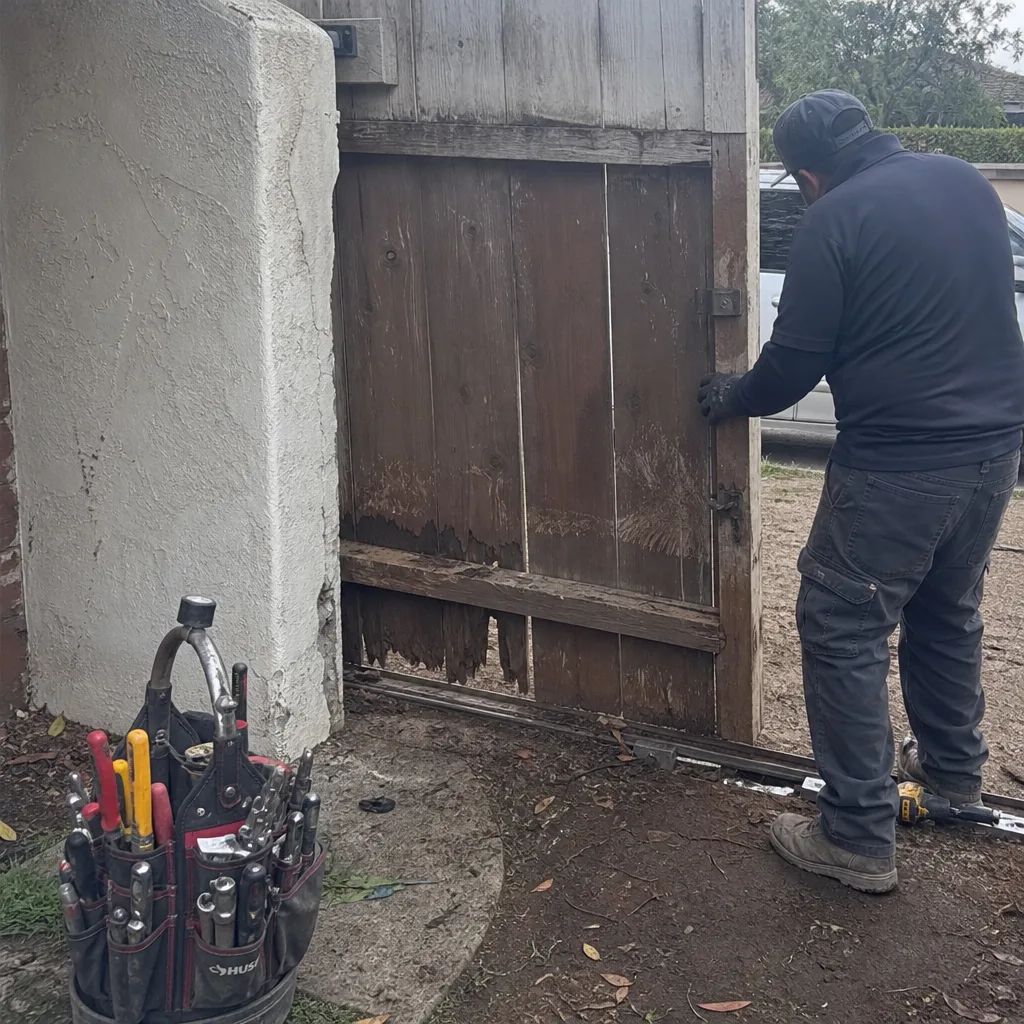 Before
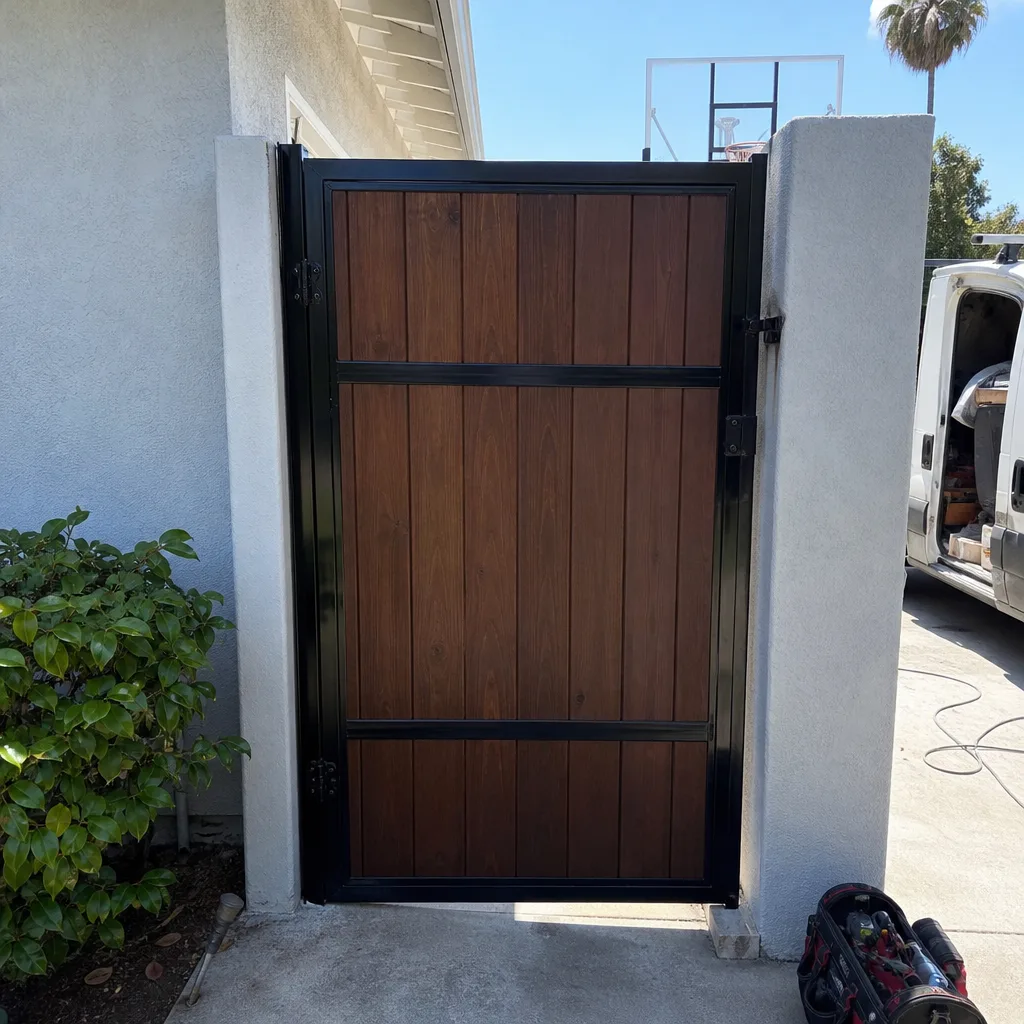 After
After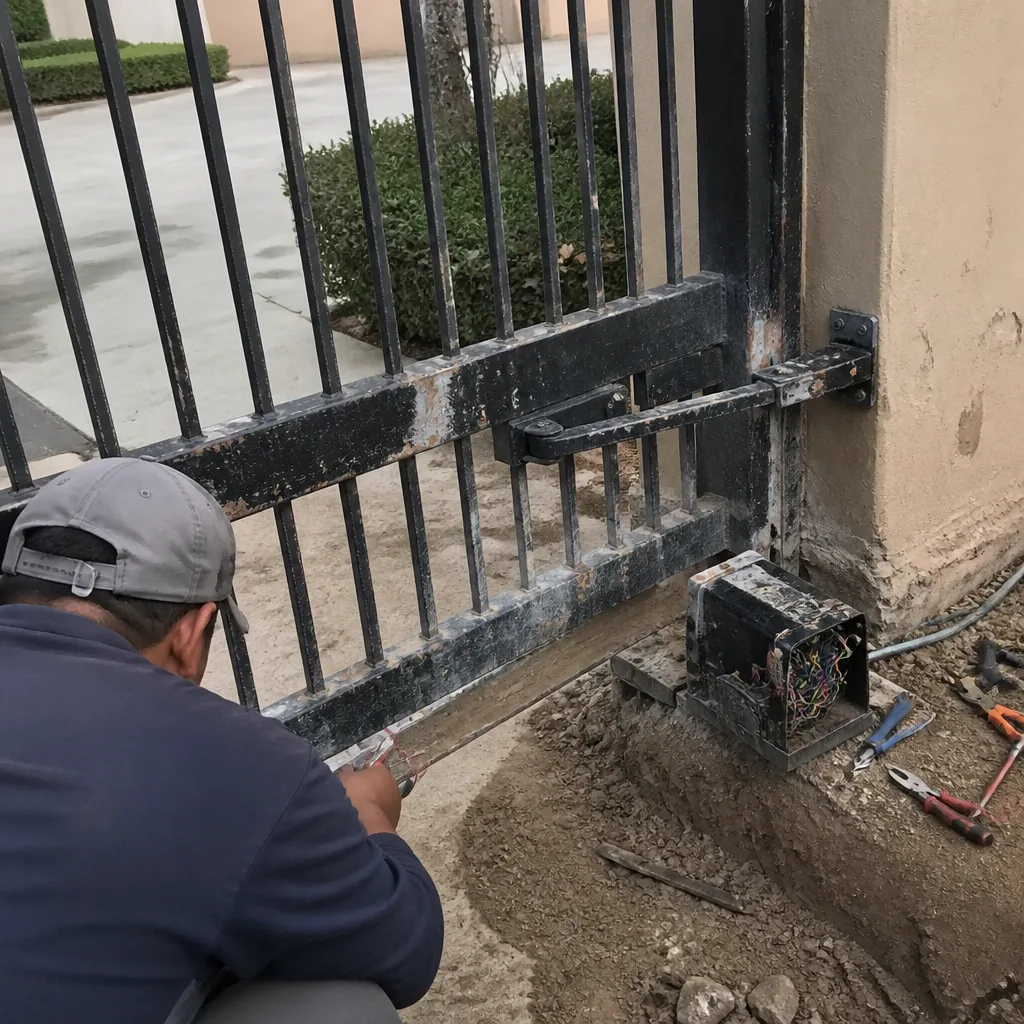 Before
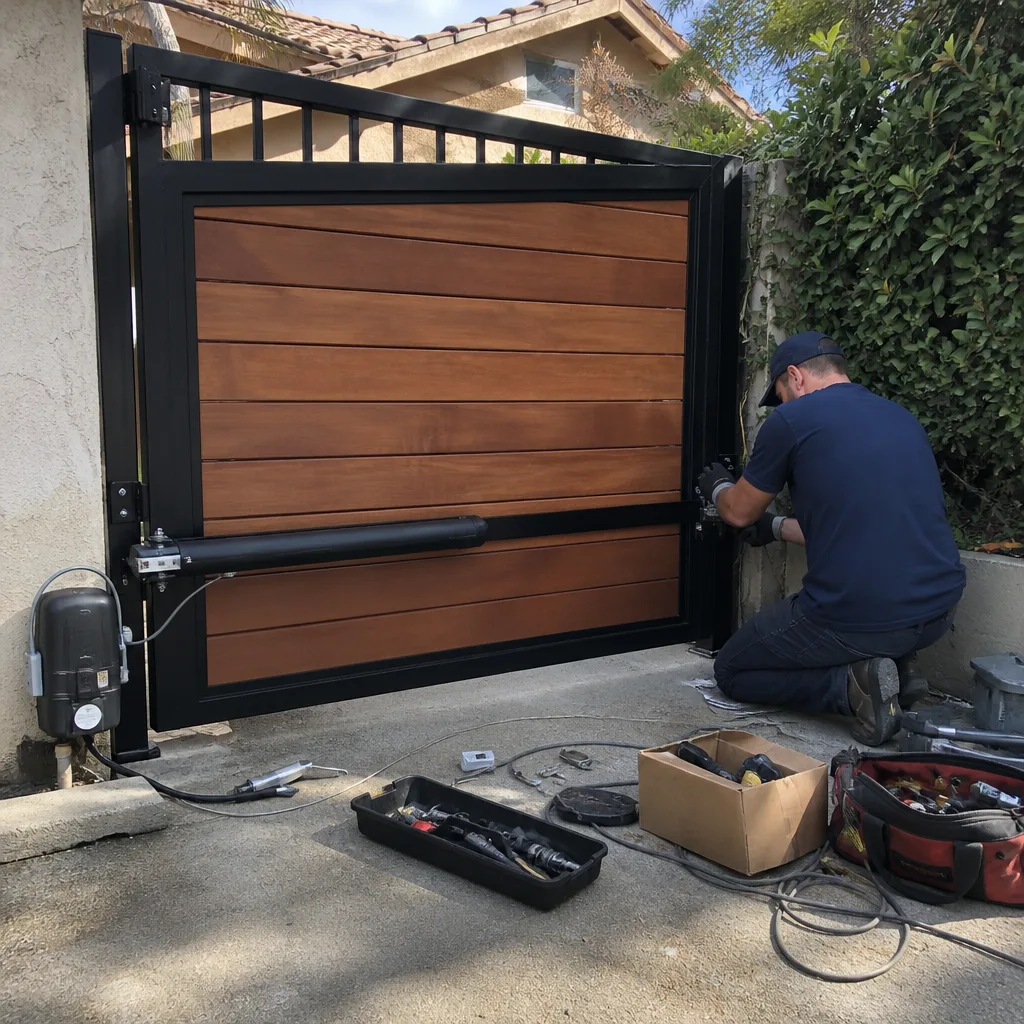 After
After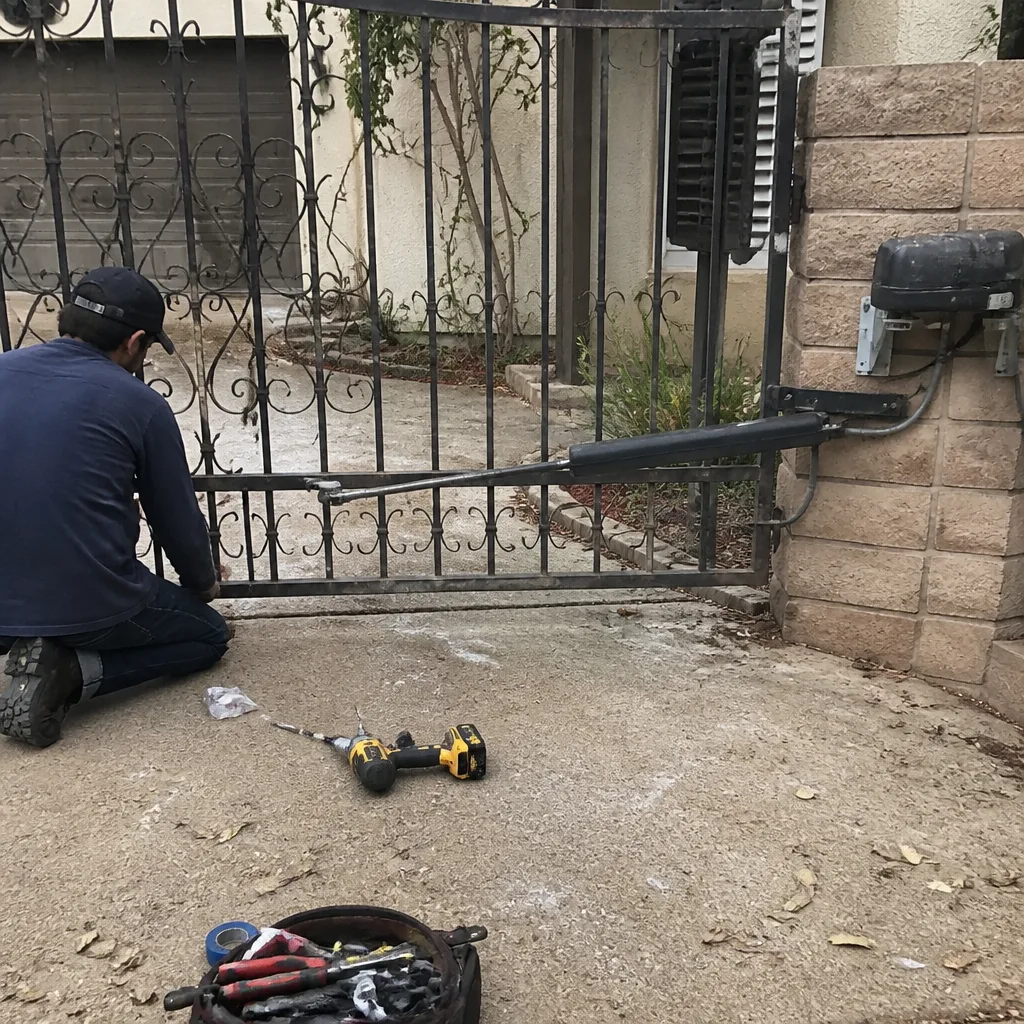 Before
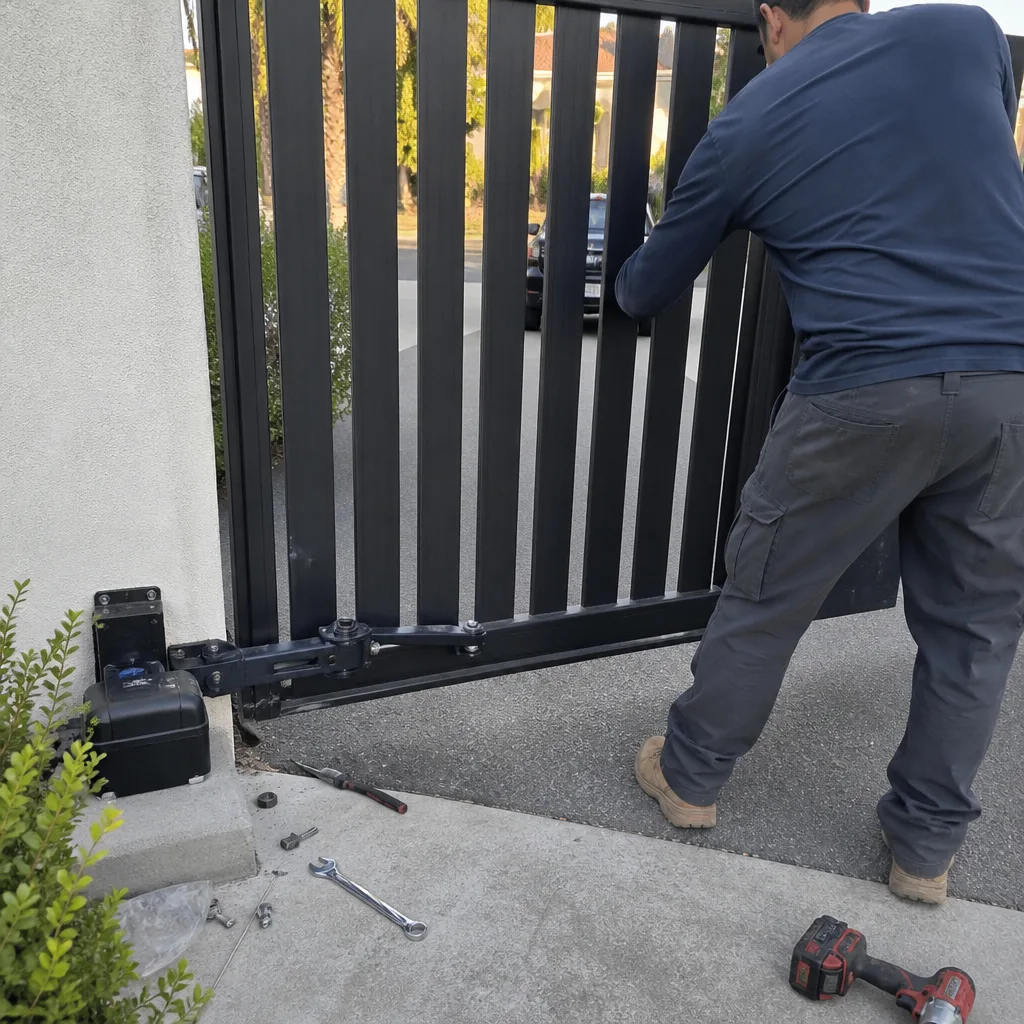 After
AfterWhen to Call a Professional
Call a professional any time the gate work involves new structural posts, new electrical circuits, or automation near a pool. These are not the jobs to split with a handyman and a Saturday afternoon. The permit path will be smoother, the inspector’s questions will have informed answers, and the work will be documented in a way that protects you. If you have an older automatic gate with no permit history, a professional can do the as-built assessment and bring it into compliance without demolition. Because some of this work involves mains voltage and automatic machinery – a gate with a high-tension spring or an actuator under load can cause serious injury if handled incorrectly – we recommend a trained professional for anything beyond basic inspection of your own gate. Portcullis Gate Repair San Diego offers free estimates in San Diego – call (619) 793-3558. We are a Portcullis Gate Repair San Diego home company, not a chain.
Frequently Asked Questions
No, not for most repairs. Replacing a hinge, wheel, roller, actuator, control board, or motor is permit-exempt under California Residential Code Section R105.2, provided the replacement parts are equivalent and no structural or electrical changes are made. Call (619) 793-3558 if you’d like a free estimate on a repair in San Diego.
It depends on the electrical and structural scope. A new automatic gate that requires new post footings or a new dedicated circuit from the panel will require a building and electrical permit. A gate that plugs into an existing GFCI outlet and uses existing posts typically does not.
UL 325 is the safety standard for automatic gate operators that requires two independent entrapment-protection devices: a reversing mechanism and external sensors like photo eyes or contact edges. It applies to every automatic gate in California, and inspectors check for compliance on every permitted installation.
Yes, but the seller must disclose it. Unpermitted work is a material fact on a California real estate disclosure. Some buyers negotiate the cost of as-built compliance. If the gate has been maintained to current safety standards, the disclosure typically does not scuttle the sale.
Most as-built compliance work in San Diego runs between $500 and $2,500, depending on how much remedial electrical and entrapment-sensor work is needed. The worst case is a full panel upgrade and a new actuator. The best case is two new photo eyes and an inspection. For an exact quote, call Portcullis Gate Repair at (619) 793-3558 – estimates are free.
Plan review for a simple residential gate runs under two weeks at the City of San Diego. The rough inspection is scheduled after the footing forms and conduit are placed, and the final inspection happens as soon as the operator and sensors are installed and energized. From application to a passed final, four to six weeks is a typical window.
The Bottom Line
For more guides & resources, see our blog. Gate permits in California are a narrow issue with a broad tail. Most repairs never need one. The work that does – new footings, new circuits, automation near a pool – is exactly the work that insurers and inspectors scrutinize most. An unpermitted gate beside a pool is a claim-time problem waiting to be discovered. The fix is not a tear-out; it is documentation. As-built compliance is a process that any competent gate contractor in San Diego can manage, and the result is a gate with a permit history, a passed inspection, and a clean future. The cost of doing it right is modest against the cost of being found without it.
Written by Dean Prescott, Owner at Portcullis Gate Repair San Diego, serving San Diego since 2008.